As we near the conclusion of 2025, I am delighted to offer my heartfelt Christmas wishes to all higher education institutions (Universities and Colleges), students, educators, parents, families, and stakeholders throughout Papua New Guinea. This festive period is a moment for gratitude, reflection, renewal and togetherness as we celebrate with our loved ones and express thanks for the year’s blessings.
This year has marked significant achievements in our higher education sector, notably the successful National Online Selection for tertiary institutions, where 13,652 school leavers and non-school leavers secured places for the 2026 academic year through a transparent and merit-based process. This accomplishment underscores our dedication to enhancing Access, Quality, and Relevance for all Papua New Guineans pursuing further higher education and skill development.
The efforts of the Department of Higher Education, Research, Science and Technology (DHERST), along with our academics, administrators, and partners, have been tireless in advancing the higher education reform, digitalization, and innovation within PNG’s higher education system. Our commitment lays the groundwork for quality, relevance, and inclusivity in higher and technical education for future generations.
As we celebrate Christmas, let us embrace the values of peace, unity, hope, and generosity. May this season bring joy and renewal to your homes, and may we all look forward to the New Year with optimism and determination to continue building a brighter future for our nation.
To all Papua New Guineans — Merry Christmas and God bless you all. May the New Year bring renewed purpose, prosperity, and continued progress to our people and our beloved country.
Authorised for release by
Hon. KINOKA FEO, MP Minister for Higher Education, Research, Science and Technology
As the Minister responsible for Higher Education, Research, Science and Technology, it is my privilege to announce to the country on the occasion of the 2025 National Online Selections for Grade 12 Students, a landmark event in our ongoing commitment to strengthening Papua New Guinea’s higher education system and ensuring that entry into tertiary education is based on fairness, transparency and merit.
As we celebrate 50 years as a nation, we look back on the journey of our education system since independence and honour the vision, leadership and commitment of those who laid its foundations and guided its growth.
Consistent with Marape-Rosso Government's higher education policy objectives for Access, Quality and Relevance, the education landscape continues to evolve in response to technological advancement. I acknowledge the leadership of the Department of Higher Education, Research, Science and Technology in implementing digital systems that support transparent, accountable and merit-based selection outcomes.
The table below presents a summary of the 2025 National Online Selections outcomes for the 2026 academic year.
Total number of Applicants
Quota/Spaces Available
Total Number of Students Selected
Grade 12 School Leavers
32,478
16,001
11,626
Non-School Leavers
2,611
8,401
2,026
TOTAL
35,089
24,402
13,652
For applicants whose information is included in the National Online Application System (NOAS) National Admissions Pool, you are reminded to regularly check your NOAS Account notifications, as higher education institutions may issue offers on an ongoing basis.
Improving access to higher and technical education and broadening opportunities for our citizens continues to be one of my key priorities. I am pleased to observe a notable increase in the student quota this year compared to 2024 and I acknowledge the Department of Higher Education, Research, Science and Technology and stakeholders for their sustained commitment to institutional registration, programme accreditation and infrastructure development in support of quality higher and technical education.
I acknowledge with gratitude the Government of Australia, through DFAT and the Australia Awards, for their partnership in using the National Online Selections System to select students for their in-Country scholarship programme for 2026.
This collaboration will open up greater opportunities for the people of Papua New Guinea and | am privileged to contribute to its realization. As the responsible Minister, | am dedicated to enhancing access to quality education by creating additional opportunities and establishing strategic partnerships with key stakeholders.
Starting in 2026, the Government of Papua New Guinea, through my Ministry, will launch a scholarship initiative to assist students from the Solomon Islands and Vanuatu in pursuing higher and technical education at recognized higher education institutions in Papua New Guinea. This program will offer a total of 70 scholarships each year for four years, with 50 scholarships designated for the Solomon Islands and 20 for Vanuatu.
This initiative underscores the governments dedication to enhancing regional collaboration and unity among Pacific Island nations. It also represents a strategic investment in fostering interpersonal connections, capacity building and educational partnerships within the Pacific region. By inviting students from neighboring countries, Papua New Guinea reaffirms its leadership in regional development and commitment to promoting shared growth through education.
I applaud the commitment and drive of everyone involved in this process. Regardless of whether you are selected this year, I urge you to stay committed to your aspirations, keep learning and take advantage of every opportunity to enhance your abilities and knowledge. You represent the future of Papua New Guinea and your education is a crucial investment in our nation's advancement.
I would like to express my gratitude to the parents, teachers, communities and mentors who supported the students throughout their educational paths. Additionally, I sincerely thank the DHERST officers and selection committees for their professionalism and commitment to ensuring that this national process is carried out smoothly and with integrity.
I wish all students the best in Your academic journey and eagerly anticipate witnessing your development into skilled professionals and conscientious citizens of Papua New Guinea.
Authorised for release by, by the Hon. KINOKA FEO, MP Minister for Higher Education, Research, Science and Technology
As the Minister responsible for Higher Education, Research, Science and Technology, I wish to address deep concerns regarding the recent incident at the University of Goroka (UoG) which occurred on Saturday, November 8, 2025. The initial confrontation occurred between students and local youths. Police regained control of the situation however there were many casualties.
I went to the UoG main campus on Sunday, November 9, 2025, together with the Hon. Robert Atiyafa, MP, Member for Henganofi. We met with students, staff, local leaders, law enforcement personnel, and appealed for peaceful resolution. Immediately instructed my Department to closely work with the UoG management, ensuring all arrangements for end-of-year student travels are prioritized. I would like to acknowledge the collective efforts by Provincial Governors, local MPs, Australian Defense Force (ADF) and all stakeholders rendered to assure students’ welfare and travels were coordinated.
I want to assure the general public that my Office, the Department of Higher Education Research Science and Technology (DHERST), and the UoG management remain committed to ensuring the academic year 2025 is successfully completed. Key actions were taken by the University in the best interest of academic continuity and student well-being. These decisions reflect the UoG Council's balanced approach, prioritizing both safety and academic integrity.
The incident at the University of Goroka unfortunately is not the only incident involving local communities and students of higher education institutions. While temporary decisions have been made in the past to contain tensions, it is evident that these measures alone are insufficient to address long-standing underlying issues.
Pursuant to Section 152 of the Higher Education (General Provisions) Act 2014, as amended in 2020, an Independent Review Committee has been appointed and will commence on the 28™ of November 2025.
Based on the Independent Review Committee report, necessary actions will be taken. The Independent Review Committee shall take a deeper and more deliberate approach, garnishing evidence, listening to all voices,and designing a lasting resolution that heals relationships for collective nation-building. | am aware of the various narratives circulating on social media. While some may be well-intentioned, many are driven by perception, emotion, or misinformation. I urge the public to allow due process to run its course. Truth must be established by facts, not opinion.
I appeal to students, staff, families, and the wider community, to support the Ministry and UoG in concluding this important course responsibly and respectfully.
Challenging situations like this, though painful, present us with critical opportunities for institutional growth and societal reflection. We must work together, Government, Universities, students, and communities, to develop long-term strategies that ensure such incidents are not chronic.
In the year of National Jubilee, let us be reminded that we are One People, One Nation, One Country. Let us build together our Future through higher education.
God bless Papua New Guinea.
Authorized by Hon. Kinoka Feo, MP Minister for Higher Education, Research, Science and Technology, and Sport.
As Minister for Higher Education, Research, Science and Technology (HERST), I am deeply concerned by the recent incident involving harassment of a female by male students at the PNG University of Technology (PNGUOT).
There is no excuse and I strongly condemn this behaviour from our students. University students are expected to exhibit a range of behaviours and attributes that demonstrates their level of intelligence, social and personal responsibility. University education in PNG is a privilege underwritten by the people of this country. Therefore, behaviours by any student or group of students that is unbecoming and lack maturity of judgement and appreciation, is not to be tolerated. Any student or group of students that do not appreciate this privilege accorded to them have no place in our universities or, for that matter, any other higher education institutions.
I have directed the Council and Administration of the PNG University of Technology (PNGUOT) to immediately:
investigate the incident;
take corrective measures, and;
furnish a full report.
The official report and measures taken by the university will be revealed when these are concluded.
In the last 10 years, PNGUOT has made significant improvements in assuring quality of its programmes such as the recent international accreditation of its Engineering programmes. Since its inception in the late 1960s, the University has produced engineers, building architects, agriculturalist, accountants and technocrats that have contributed to the development of this country. Hence, I have confidence in the current Council and Administration to promptly and effectively address this issue so that the positive gains are not compromised by this single deviant behaviour.
Authorised by Hon. Kinoka Feo. MP. Minister for Higher Education, Research, Science and Technology
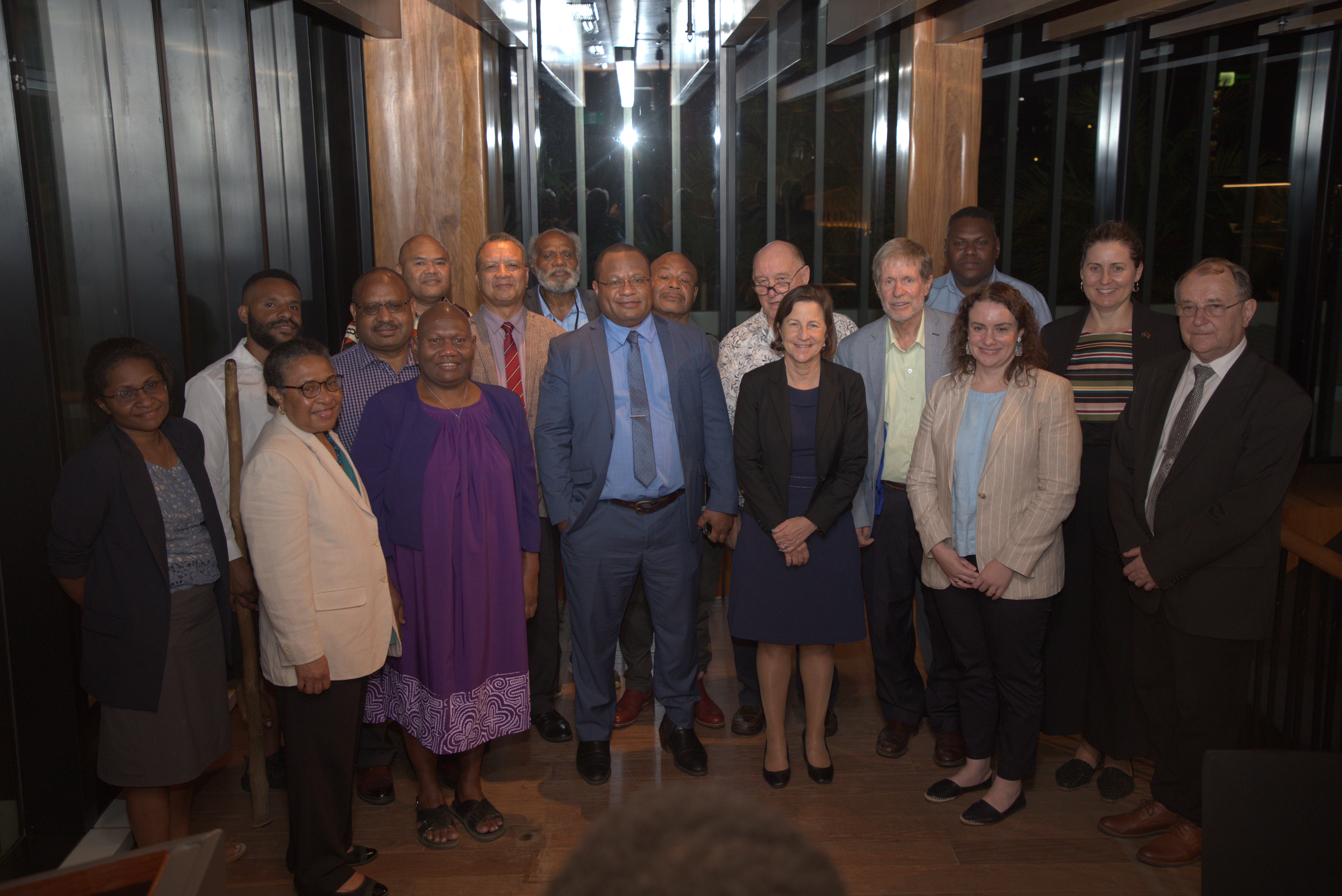
The Australia High Commission hosted a dinner at the Hilton Hotel to honor the newly sworn-in Minister for Higher Education, Research, Science, Technology, and Sport, Hon. Kinoka Feo, along with the Member for Unggai-Bena and all seven University Vice-Chancellors and Research Institute Directors.
In his opening remarks, Minister Feo reflected on his brief but impactful career in tertiary education, particularly his role as a Development Director at Pacific Adventist University. He expressed a strong commitment to advancing the higher education sector.
Minister Feo raised several critical concerns during his address. He highlighted the significant challenge posed by the large number of Grade 12 graduates from National High Schools and Secondary Schools, which totals over 20,000 annually, compared to the available 10,000 spaces in tertiary institutions. "We need to work closely in taking in more students in our tertiary levels by creating more infrastructures," he emphasized.
The Minister also acknowledged the Australian government's contributions, particularly in providing scholarships and project funding for educational institutions.
He expressed deep appreciation for the efforts of the administrators across all tertiary institutions, admitting that while he may not know everything about the sector, he is eager to collaborate with the highly educated leaders to ensure that these institutions provide the best knowledge and skills to the nation's citizens.
Theme: Envisioning Tomorrow's Academia and Research: Pioneering Innovation and Collaboration to Transform Universities and Research Institutions in Papua New Guinea
Minister Hon. Kinoka Feo began his speech with a heartfelt story. Shortly after his election, he was passing by a group of people and recognized his Grade 3 teacher. He went up to him, hugged him, and said thank you. As he walked away, he heard his teacher proudly telling everyone, "He was my student." Minister Feo emphasized that teaching is one of the most rewarding careers, noting that the future of any country lies in the hands of its teachers. He proceeded to thank all the teachers present in the audience, saluting them for their noble contributions to building the nation. He further highlighted that the Higher Education Department, comprised of highly educated individuals, should lead the country in embracing cutting-edge technology and innovation.
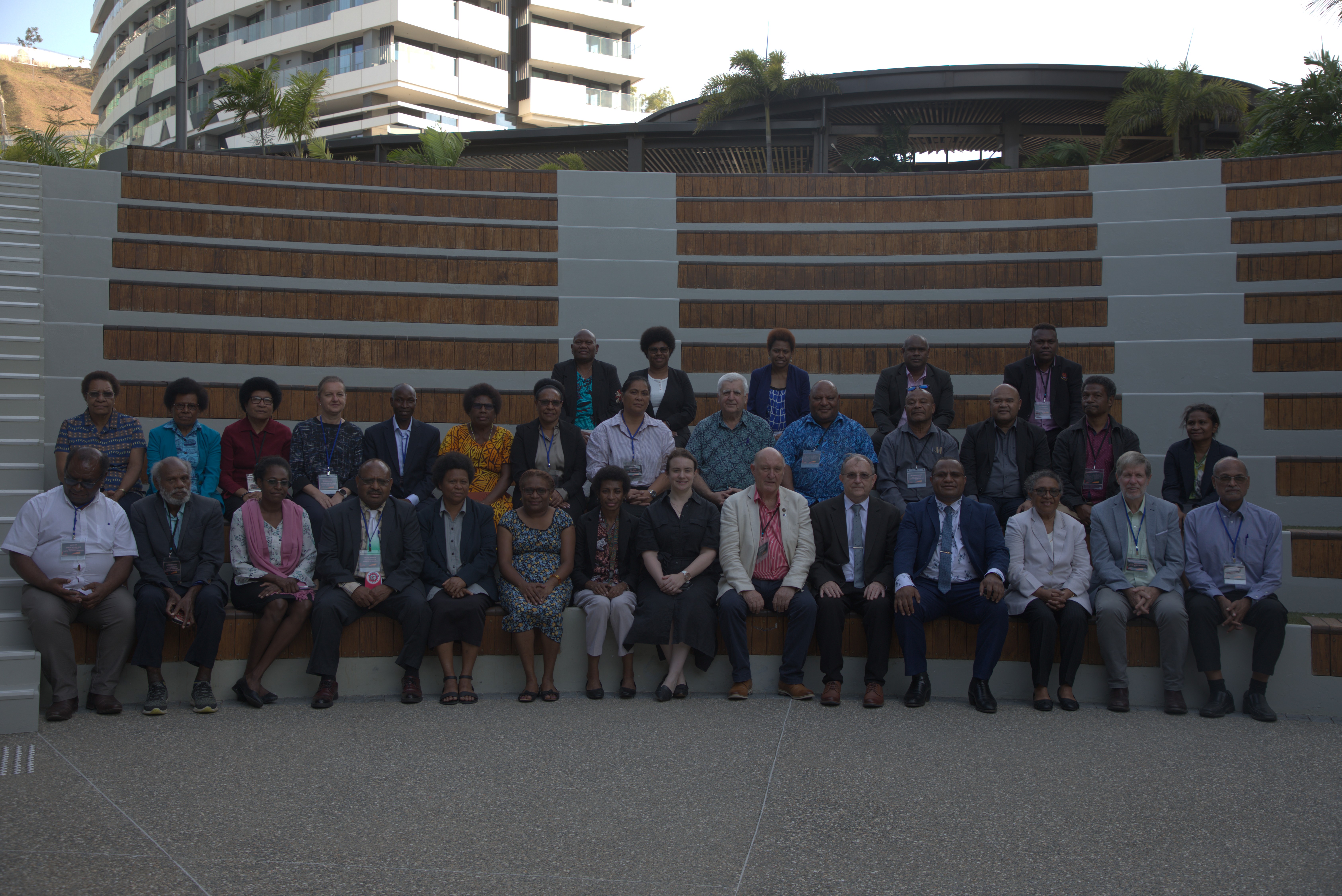
Minister Kinoka Feo addressed the annual conference, emphasizing the need to reshape and innovate the higher education and research sectors in Papua New Guinea. His speech focused on three key pillars, quality assurance, good governance, and digitalization.
Minister Feo highlighted the importance of maintaining high standards in teaching, research, and governance. He stressed the need for continuous evaluation and improvement to enhance the credibility and value of education.
He underscored the role of ethical leadership and transparency in managing institutions effectively. Emphasizing integrity and accountability, Minister Feo called for a collaborative approach to governance, involving all stakeholders in decision-making processes.
Minister Feo advocated for the adoption of digital tools to facilitate collaboration, enhance data sharing, and streamline administrative functions. He emphasized the need for investment in digital infrastructure and literacy to create a more connected and efficient academic environment.
Minister Feo also outlined key focus areas; Policies and Amendments, reviewing and updating policies to align with global best practices, developing new proposals, and ensuring effective implementation.
Funding and Partnerships, diversifying funding sources and forming strategic partnerships to enhance research capabilities and ensure sustainability. Research and Digitalization, assessing current infrastructure, implementing digital tools, and building capacity in digital literacy and research methodologies.
He concluded by expressing confidence in achieving the vision of pioneering innovation and collaboration in academia and research, with a commitment to transforming institutions into world-class centers of excellence.
As the Minister of Higher Education, Research, Science, Technology, and Sports, I am pleased to announce to the public that commencing this year, for the academic year 2025, the selection of non-school leavers will no longer be conducted manually by registered higher education institutions, including universities.
In the year 2024, the National Online Selection System (NOSS) and National Online Application System (NOAS) are slated for expansion to encompass non-school leavers, marking a significant development in higher education accessibility.
As an initial measure, HEI’s Selectors interface is being enhanced to enable the simultaneous definition of program quotas, requirements, and rankings for both school leavers and non-school leavers. Non-school leaver quotas will be established in a manner consistent with that of school leavers, ensuring alignment with maximum HEIs quotas as defined by DHERST Quality Assurance Division, reflective of institutional capacity. Requirements for non-school leavers will parallel those for school leavers, with flexibility for HEIs to incorporate additional local criteria such as work experience. Rankings for non- school leavers, built upon existing school leaver criteria, will factor in local requirements as designated by HEIs.
In the subsequent phase, DHERST will proceed to create accounts for Centres of Distance Education (CDEs), including entities such as FODE (central and provincial centers) and Universities’ Matriculation Centers, such as PNG UoT, DWU, and UoG. These entities will be tasked with submitting nomination lists to DHERST for students who have either completed G12 exams outside of conventional secondary school environments or have undergone result upgrades.
The application process for non-school leavers will commence upon the submission of nomination lists from CDEs. Eligible non-school leavers listed therein may obtain invitation letters from their respective CDEs. Former school leavers opting not to upgrade their G12 results will have the option to reactivate their NOAS account to participate in selection as non-school leavers.
The application procedure for non-school leavers will mirror that of school leavers, albeit limited to programs with designated non-school lever quotas. Non-school leavers may apply to five prioritized programs and submit backup applications. Following selection, non-selected non-school leavers will be placed in the National Admission Pool.
The integration of non-school leavers into NOSS and NOAS systems is envisioned to streamline the selection process while upholding principles of transparency, efficiency, and accountability. It is important to note that an age limit will be instituted for non-school leavers applying to regular academic programs.
This extension of NOAS and NOAS to encompass non-school leavers marks the inaugural phase of a comprehensive higher education management system, poised to encompass TESAS, including travel support, quality assurance programs, and significant extensions to existing modules.
I hereby announce to the public and all higher education institutions (HEIs), including universities, that beginning this year, student selection procedures will be conducted solely through digital platforms. I encourage all HEIs to liaise with the Department and jointly embrace this innovative initiative. Our collective aim is to improve the sector by enhancing quality, accessibility, student success, and academic attainment through digitalization. This endeavor will contribute significantly to nurturing the necessary human capital required to advance Papua New Guinea’s socio-economic development agenda.
Hon. Don Pomb Polye, CMG, BE(Civil) MBA, MIEPNG, MP Minister of Higher Education, Research, Science and Technology, and Sports
The core objectives of the Regional workshops were to inform stakeholders particularly the Higher Education Institutions (HEIs) of the Marape-Basil Government’s progress in implementing the Government’s commitment to reform, transform and unify the higher education system in Papua New Guinea. It was also an opportunity to receive feedback from the HEIs on relevant information concerning the five enabling key result areas namely: Budget; Governance; Human Resource; Programme Accreditation process for Private Training Provider Institutional; Digitalisation, and the; Registration under DHERST.
The reform is a direct result of the National Executive Council (NEC) Decision No: 54/1995 and No: 25/2017 to have all post-secondary institutions under the oversight of the Ministry for Higher Education, Research, Science and Technology.
The higher education transition and reform agenda is also captured in the Marape Manifesto and in the Social and Law & Order Sector (SLOS) Strategic Framework 2019-2022.
Why Reform?
For more than three decades, the higher education sector has been fragmented across at least eight different Ministries, with all post- secondary institutions coming under different regulatory and administrative frameworks. This has resulted in uneven quality and very often funding diverted to non-priority areas of the Government. Many ad-hoc post-secondary courses and programmes have been developed without proper quality assurance oversight or very little engagement with industry or adherence to industry standards. Consequently, the planned reform are therefore, necessary to empower institutions under DHERST regulatory oversight; strengthen funding arrangements for church agency institutions; support all post-secondary institutions in contributing to national skills priorities and a highly skilled and competitive workforce.
Why workshop?
The aim of the regional workshops was to engage with the stakeholders especially HEIs, Provincial Governments and Provincial Education representatives in explaining the reform outcomes and in understanding their role as important changes in higher education take place during the transitional period over the next 12 months and the reform period beyond. The workshop provided an opportunity for the Ministry and Department to demonstrate the Government’s strong commitment to the transition and reform agenda; and offered participants an opportunity to contribute constructively to the ongoing transformation of education quality.
Stakeholder feedback
Participants from the HEIs at the Governing Councils and Administration levels across the country, Provincial Government and Provincial Education representatives from the Region, expressed their strong support for the landmark changes occurring in the higher education sector.
Many acknowledged that the reforms are the most significant to occur in higher education in over three decades. Very constructive critiques and feedback were provided to DHERST that NGI Participants Momase Participants Southern Participants Highlands Participants conveyed momentum and support for the reforms, balanced with the need for ongoing consultation with individual institutions, the reliability of core government funding and ongoing capacity development support.
Way Forward/Next Steps
Following the Regional Workshops (Kokopo, NGI- 15-16 July, Madang, Momase 22-23 July, NCD, Southern 26-27 July, and Mt. Hagen, Highlands 29-30 July), DHERST will continue its engagement with on-going dialogue and collaboration to rollout the reform agenda with further Consultative workshops. The next phase of the reform is the review of the National Higher and Technical Education (NHTEP) 2015-2024 and the development of the National Skills Development Plan. The restructure of the Department will follow the policy reviews and Development.
The Ministry and Department of Higher Education, Research, Science and Technology will continue to engage with all stakeholders especially the higher education institutions in the country during the transition period.
Approved for Release
Hon. Wesley Ora Raminai, MP Minister for Higher Education, Research, Science and Technology & Sports (Member for Kagua Erave)
Reforming, Transforming and Unifying the Higher Education System in
Papua New Guinea
Under the leadership of the Prime Minister Rt Hon.
Peter O’Neill, CMG, MP the National Executive Council has approved the policy submission on Reforming, Transforming and Unifying the Higher Education System in Papua New Guinea on the 18th of October 2017by the National Executive Council Decision Number NG25/2017. The Government of Papua New Guinea through the Department of Higher Education, Research, Science and Technology (DHERST) developed a strategic plan which aims at introducing necessary changes to the Higher Education Sector, one of the most critical changes in higher education is the recognition that increasing access to Higher Education Institutions (HEI) is not enough. The objective of this strategic plan is to help as many students as possible to gain entry to universities or colleges, to offer a quality of education and most importantly, help them succeed once they have enrolled. That fundamental reorientation in focus is profound. It means that the DHERST together with Higher Education Institutions will work to implement the Higher Education Strategic Plan and develop and implement its own strategies that will best enable students to meet their educational goals, whether they are pursuing a degree or striving toward some other educational objective hence contributing to the economic and social development of the country.
The Government working through the DHERST will reform, transform and unify the Higher Education sector in Papua New Guinea to energize and unlock the minds and potential of young citizens for brighter economic prospects is one of the Governments' primary objectives, and it becomes the principal strategy of the DHERST. The quality of education at all levels is crucial for increasing PNG’s human and economic development, prosperity and competitiveness. The Government of today with my leadership as the Minister responsible for the reform those activities has tasked the DHERST to implement the strategy that aims at refining and providing greater focus in the implementation of the PNG's Government Education Sector Policy. It will contribute to the acceleration of economic growth through the provision of much-needed expertise in research, science and technology, including intermediate and higher level vocational and technical skills. The reform in the higher education sector considers technical and vocational training as an integral part of the higher education sector and recognizes it as a crucial factor in skills development and in fostering research, science, technology and innovation, particularly in the application, adaptation and use of technologies. The building of a skilled workforce with the capacity to replace current scores of skilled expatriate workers also has significant sustainable benefits to the PNG economy and community.
The Government of PNG (GoPNG) is investing in the higher education sector, as a critical enabler to enhance the economic and social developments of PNG and to implement the Vision 2050 to transform our people and our nation by reforming our mindsets and attitudes. This strategic plan will provide the direction to reform, transform, unify and align our institutions and systems to make ‘Papua New Guinea become a smart, wise, fair, healthy and happy Society by 2050. Thus, the Government is making a long-term investment in the higher education sector, and it sees it as a necessary and proper investment.
National Executive Council directed the DHERST to implement the Higher and Technical Education Strategic Implementation Plan 2017-2038. A roadmap to achieve the aims of the Higher and Technical Education Sector in Papua New Guinea, the PNG National Qualifications Framework and Relative Funding Model.
Therefore, I am delighted to formally open the workshop which aims to create a new structure of the DHERST so it can have the capacity to serve and felicitate implementation of reforms, transformation and unification of the higher education system in Papua New Guinea.
As Jesus Christ said in Matthew 9.17: "And no one putsnew wine into old wineskins. For the old skins would burst from the pressure, spilling the wine and ruining the skins. New wine is stored in new wineskins so that both are preserved."
Let Jesus' words be for us a guiding philosophy for this restructuring process. The Department’s structure must be designed in a manner that supports the objectives of the Strategic Plan and considers NEC Decision Number NG25/2017. All of its divisions and functions must be of the right type and placed in the correct location so that the entire system works well together to serve all Higher Education Institutions and facilitate necessary developments. We cannot implement NEC directives in the current organizational structure as Jesus said new purpose, a new strategic plan requires a new organizational structure.
The design of a new structure needs to support the purpose of the Department hence every division and section within it must serve a particular purpose. The mission of the Department is to serve and facilitatedevelopments in the Higher Education Sector in PNG.
The other task is to develop the right organizational culture. The DHERST’s culture must be dynamic. As often we will shift, incrementally and continuously, in response to external and internal changes. Thus, creating an organizational culture is complicated as it must be open to the possibility that culture change can be managed as a continuous process rather than through significant shifts and this is only possible if we create DHERST’s culture based on Christian principles and the Departments’ core values as such: Honesty, Integrity, Accountability, Respect, Wisdom and Responsibility.
I would like to see that the Higher Education Sector in PNG embraces eLearning and considers all benefits for learners that are available in the cloud. Therefore, research must be at the heart of the Sector and the Department. Research must influence and advice learning and teaching as well as the decisions we will make in the Department. Please ensure that we create e-Department.
Thank you for your willingness to take those tasks. May the Lord bless your work and guide you in this very challenging task.
HON. PILA NININGI, MP, LLB
Higher Education, Research, Science and Technology
Under the leadership of the Prime Minister Rt Hon. Peter O'Neill, CMG, MP the National Executive Council has approved the policy submission on Reforming, Transforming and Unifying the Higher Education System in Papua New Guinea on the 18th of October 2017 by the National Executive Council Decision Number NG25/2017. The Government of Papua New Guinea through the Department of Higher Education, Research, Science and Technology (DHERST) developed a strategic plan which aims at introducing necessary changes to the Higher Education Sector, one of the most critical changes in higher education is the recognition that increasing access to Higher Education Institutions (HEI) is not enough. The objective of this strategic plan is to help as many students as possible to gain entry to universities or colleges, to ouer a quality of education and most importantly, help them succeed once they have enrolled. That fundamental reorientation in focus is profound. It means that the DHERST together with Higher Education Institutions will work to implement the Higher Education Strategic Plan and develop and implement its own strategies that will best enable students to meet their educational goals, whether they are pursuing a degree or striving toward some other educational objective hence contributing to the economic and social development of the country.
The Government working through the DHERST will reform, transform and unify the Higher Education sector in Papua New Guinea to energize and unlock the minds and potential of young citizens for brighter economic prospects is one of the Governments' primary objectives, and it becomes the principal strategy of the DHERST. The quality of education at all levels is crucial for increasing PNG's human and economic development, • prosperity and competitiveness. The Government of today with my leadership as the Minister responsible for the reform those activities has tasked the DHE.RST to implement the strategy that aims at refining and providing greater focus in the implementation of the PNG's Government Education Sector Policy. It will contribute to the acceleration of economic growth through the provision of much-needed expertise in research, science and technology, including intermediate and higher level vocational and technical skills. The reform in the higher education sector considers technical and vocational training as an integral part of the higher education sector and recognizes it as a crucial factor in skills development and in fostering research, science, technology and innovation, particularly in the application, adaptation and use of technologies. The building of a skilled workforce with the capacity to replace current scores of skilled expatriate workers also has significant sustainable benefits to the PNG economy and community. The Government of PNG (GoPNG) is investing in the higher education sector, as a critical enabler to enhance the economic and social developments of PNG and to implement the Vision 2050 to transform our people and our nation by reforming our mindsets and attitudes. This strategic plan will provide the direction to reform, transform, unify and align our institutions and systems to make 'Papua New Guinea become a smart, wise, fair, healthy and happy Society by 2050. Thus, the Government is making a long-term investment in the higher education sector, and it sees it
as a necessary and proper investment. National Executive Council directed the DHERST to implement the Higher and Technical Education Strategic Implementation Plan 2017-2038. A roadmap to achieve the aims of the Higher and Technical Education Sector in Papua New Guinea, the PNG National Qualifications Framework and Relative Funding Model.
Therefore, Iam delighted to formally open the workshop which aims to create a new structure of the DHERST so it can have the capacity to serve and felicitate implementation of reforms, transformation and unification of the higher education system in Papua New Guinea.
As Jesus Christ said in Matthew 9.17: "And no one puts new wine into old wineskins. For the old skins would burst from the pressure, spilling the wine and ruining the skins. New wine is stored in new wineskins so that both are preserved."
Let Jesus' words be for us a guiding philosophy for this restructuring process. The Department's structure must be designed in a manner that supports the objectives of the Strategic Plan and considers NEC Decision Number NG25/2017. All of its divisions and functions must be of the right type and placed in the correct location so that the entire system works well together to serve all Higher Education Institutions and facilitate necessary developments. We cannot implement NEC directives in the current organizational structure as Jesus said new purpose, a new strategic plan requires a new organizational structure.
The design of a new structure needs to support the purpose of the Department hence every division and section within it must serve a particular purpose. The mission of the Department is to serve and facilitate developments in the Higher Education Sector in PNG.
The other task is to develop the right organizational culture. The DHERST's culture must be dynamic. As often we will shift, incrementally and continuously, in response to external and internal changes. Thus, creating an organizational culture is complicated as it must be open to the possibility that culture change can be managed as a continuous process rather than through significant shifts and this is only possible if we create DHERST's culture based on Christian principles and the Departments' core values as such: Honesty, Integrity, Accountability, Respect, Wisdom and Responsibility.
I would like to see that the Higher Education Sector in PNG embraces elearning and considers all benefits for learners that are available in the cloud. Therefore, research must be at the heart of the Sector and the Department. Research must influence and advice learning and teaching as well as the decisions we will make in the Department. Please ensure that we create e-Department.
Thank you for your willingness to take those tasks. May the Lord bless your work and guide you in this very challenging task.